
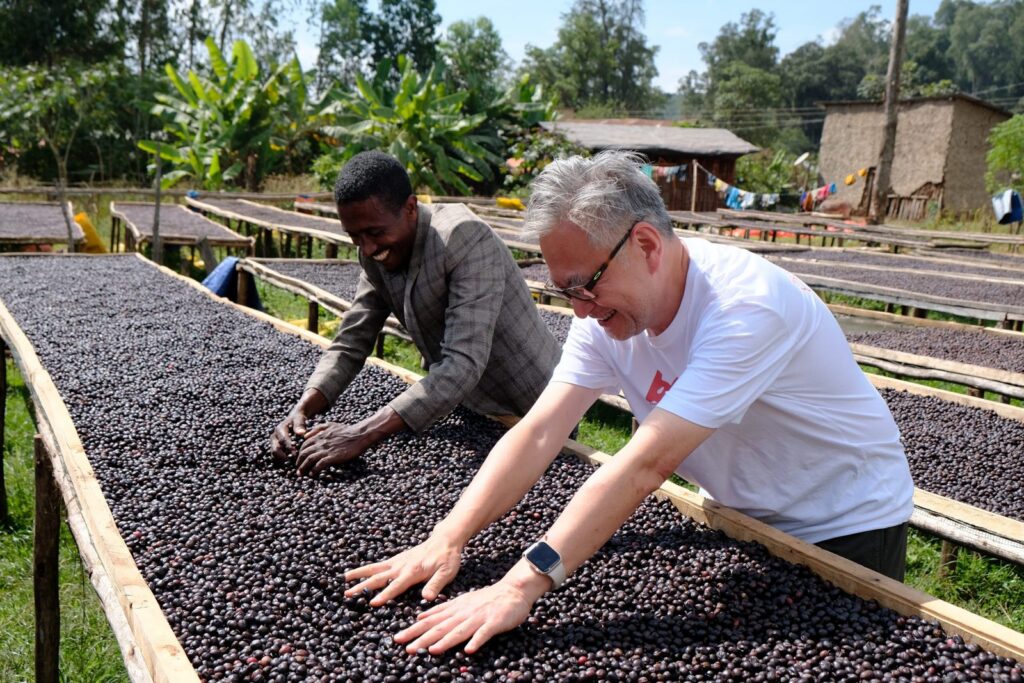
In Hong Kong, “doing business” has long been synonymous with the relentless pursuit of efficiency and profit. Yet a paradigm shift is underway. A growing number of enterprises are challenging the status quo, asking: must financial viability come at the expense of stakeholder wellbeing? This consciousness is taking root in our local ecosystem, and the story of Coffee BOATS stands as a compelling embodiment of this evolution. As a purpose-driven brand currently pursuing B Corp Certification, Coffee BOATS is exploring how commercial viability and positive social impact can reinforce one another through its business model and operations.

The journey of Coffee BOATS began in 2018 as a community co-creation initiative. Caritas Mok Cheung Sui Kan Community Centre collaborated with Grosvenor to launch the “Shared Kitchen” in Shek Tong Tsui, offering a communal cooking space for residents of subdivided flats and grassroots communities. The core goal was straightforward: foster neighbourhood mutual aid and empower women entrepreneurs through hands-on coffee roasting workshops and training.

Post-pandemic, with support from the Social Innovation and Entrepreneurship Fund (SIE Fund) and Oxfam Grant for Good, Caritas launched the “Neighbourhood Kitchen-Own Brand” project in 2024, continuing to help women, youth, and disadvantaged communities by teaching coffee roasting skills to help them become self-reliant. At that time, Ringo Lam, now Coffee BOATS’ Chief Bean Officer, served as the project’s coffee roasting consultant. To ensure long-term viability, he sought to develop this volunteer-driven service into a sustainable enterprise.

On the Journey towards B Corp Certification
When Lam shared this “transformation” idea with the Cardinal of the Hong Kong Catholic Diocese, the Cardinal noted that traditional social enterprises can face challenges in sustaining operations when funding is limited or when business models are unable to support long-term development. This immediately reminded Lam of his coffee roasting studies in the United States, where he had encountered the B Corp movement and companies such as Equator Coffees, a Certified B Corporation in the coffee industry.

Lam then studied Equator Coffees’ practices, personally visited its roasting facility in San Rafael, and consulted members of Hong Kong’s B Corp community. This groundwork strengthened his resolve to evolve the welfare project into a purpose-driven private enterprise. Today, Coffee BOATS is a Pending B Corp, working towards B Corp Certification and using the new B Lab Standards as a reference point for strengthening its business practices and impact.

To put these principles into practice, Coffee BOATS is integrating its commitment to giving back to society into its core business model. As a key initiative, Coffee BOATS donates 20% of revenue from each bag of coffee directly to Caritas Hong Kong, demonstrating how commercial activity and meaningful social impact can be designed to reinforce one another.
To shield customers from inflated prices whilst maintaining its commitment to Caritas, Coffee BOATS strategically reduced overheads in rent, marketing, and distribution. Its sales channels are primarily online and through select church-based outlets, leveraging community networks for cost-effective promotion. At the same time, its journey towards B Corp Certification provides a framework for examining how its social and environmental commitments can be embedded more systematically into its operations.

From Scepticism to Conviction in the B Corp Framework
Lam admits that when he first encountered the B Corp philosophy, he maintained a sceptical attitude. In the modern business environment, juggling challenges like cost control, cash flow, and market competition already leaves entrepreneurs overwhelmed—isn’t talking about ideals too impractical?
As he encountered more examples of B Corps, however, particularly in the international coffee industry, Lam discovered that B Corp is not simply a slogan but a framework through which businesses can examine, measure and continuously improve their social, environmental and governance practices.
Under B Lab’s new standards, companies are assessed across seven Impact Topics: Purpose & Stakeholder Governance; Fair Work; Justice, Equity, Diversity & Inclusion; Human Rights; Climate Action; Environmental Stewardship & Circularity; and Government Affairs & Collective Action. For Coffee BOATS, working towards B Corp Certification provides an opportunity to examine its policies, practices and impact more systematically and identify areas for continued improvement.

People-Centred: From Employee Training to Fair Wages
Under the B Corp framework, employees are recognised as important stakeholders in how a company creates value. Coffee BOATS must therefore also face a practical challenge: balancing market wages with the enterprise’s capacity.
Danny Yip, Bean2bit Crafter at Coffee BOATS, notes: “In terms of employee arrangements, we provide corresponding technical support and training for different positions’ needs. This not only supports good working conditions but also helps the enterprise retain talent in the long term.”

Environmental Stewardship as Routine, Not Rhetoric
Coffee BOATS is also examining how environmental considerations can be incorporated into everyday operations, including packaging and logistics. The company is phasing in recyclable and biodegradable materials and renegotiating supplier terms to keep environmental improvements affordable for its operations.
These incremental shifts reflect an approach centred on continuous improvement—recognising that meaningful environmental progress often requires businesses to review and strengthen their practices over time.

Sustainability Equals Transparent and Long-Term Decision-Making
Regarding the balance of profit, purpose, and impact, Lam emphasises that decisions should be transparent and grounded in long-term thinking. He believes “direct trade” and “bulk purchasing” can significantly reduce operating costs, whilst a clear social impact can attract like-minded partners, employees, and customers.
Though these values may not deliver immediate financial returns, Lam believes they can help build organisational resilience and sustainable competitive advantage over time.

The B Corp Journey: Building Trust and Long-Term Value
In recent years, more consumers and corporate clients have begun looking for businesses that can demonstrate clear social and environmental commitments. For companies pursuing B Corp Certification, the process provides an opportunity to examine their practices against verified standards and support their claims with relevant evidence.
For Coffee BOATS, becoming a Pending B Corp does not mean that the company has completed the certification process. Rather, it marks a stage in its journey towards B Corp Certification and reflects its intention to continue strengthening its social, environmental and governance practices.
Lam sees this journey as one of continuous improvement. In a rapidly changing market, businesses that can respond to both commercial realities and evolving stakeholder expectations may be better positioned to build long-term resilience and trust. For Coffee BOATS, pursuing B Corp Certification is therefore not simply about achieving a certification—it is about using a structured framework to examine how the business can continue to improve and create lasting value.